A royal square between the Tuileries and the Champs-Élysées
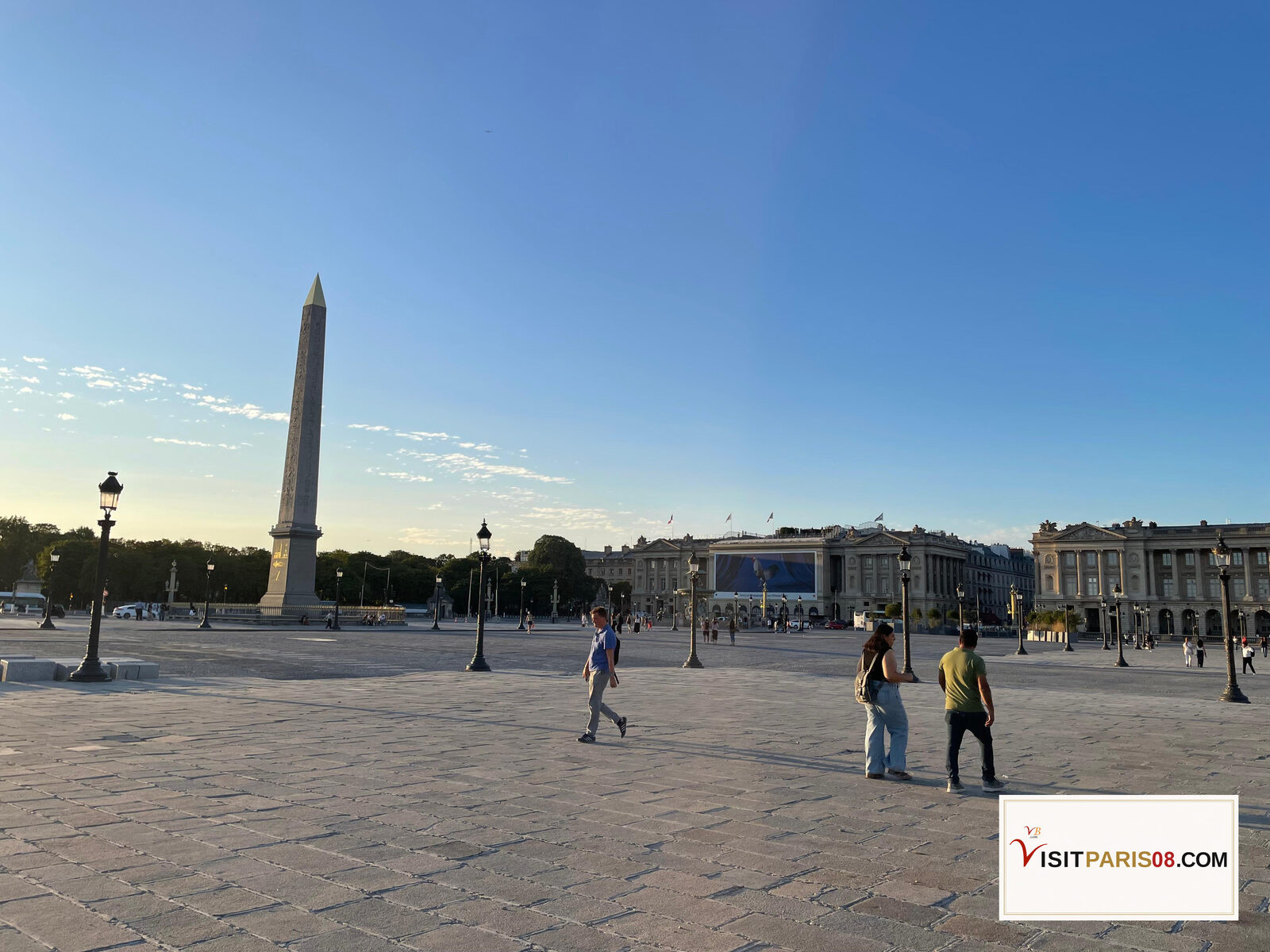
The largest square in Paris, crowned by the 3,300-year-old Luxor Obelisk and two monumental fountains. Laid out in the 18th century between the Tuileries gardens and the foot of the Champs-Élysées, it is framed by the Hôtel de Crillon and the Hôtel de la Marine.
- 🏛️TypeMonumental square
- 📍AddressPlace de la Concorde, 75008 Paris
- 🎟️AdmissionOpen access · free
- 🕑AccessOpen access · free
- 🚇AccessMétro Concorde (1, 8, 12) — on the square
- 🗺️NearbyThe Tuileries, the Madeleine and the Champs-Élysées all meet at the square; the Grand & Petit Palais are a short walk away.
The Obelisk & the Eight Cities of France
How the largest square in Paris became a map of the whole country.
The square took its present shape under King Louis-Philippe, in a redesign led by the architect Jacques-Ignace Hittorff between 1836 and 1840. At its centre stands the Luxor Obelisk, a 3,300-year-old monument from the Temple of Ramesses II, offered to France by Egypt and raised on 25 October 1836. Two monumental fountains — the Fountain of the Seas and the Fountain of the Rivers — frame it.
Eight women, eight cities
Hittorff crowned the eight corners of the octagonal square with eight monumental statues, each a seated woman wearing a mural crown — the emblem of a great French city: Lille, Strasbourg, Rouen, Brest, Lyon, Marseille, Bordeaux and Nantes. Carved between 1836 and 1840 by four sculptors — James Pradier (Lille, Strasbourg), Jean-Pierre Cortot (Rouen, Brest), Pierre Petitot (Lyon, Marseille) and Louis-Denis Caillouette (Bordeaux, Nantes) — each city was placed on the side of the square turned toward its own region, so that the eight together map the kingdom around its capital.
The statue of Strasbourg became the most famous of all: after the loss of Alsace in 1871, it was draped in black and covered with flowers until 1918, a national shrine of patriotic memory.
A dedicated page tells the story of each of the eight statues — click a marker, or choose a city below.
Explore the eight city statues
Where it is — and what's around
Place de la Concorde (pulsing marker) at the centre. Toggle the filters to show the heritage, restaurants and activities of the 8th — and the hotels around.