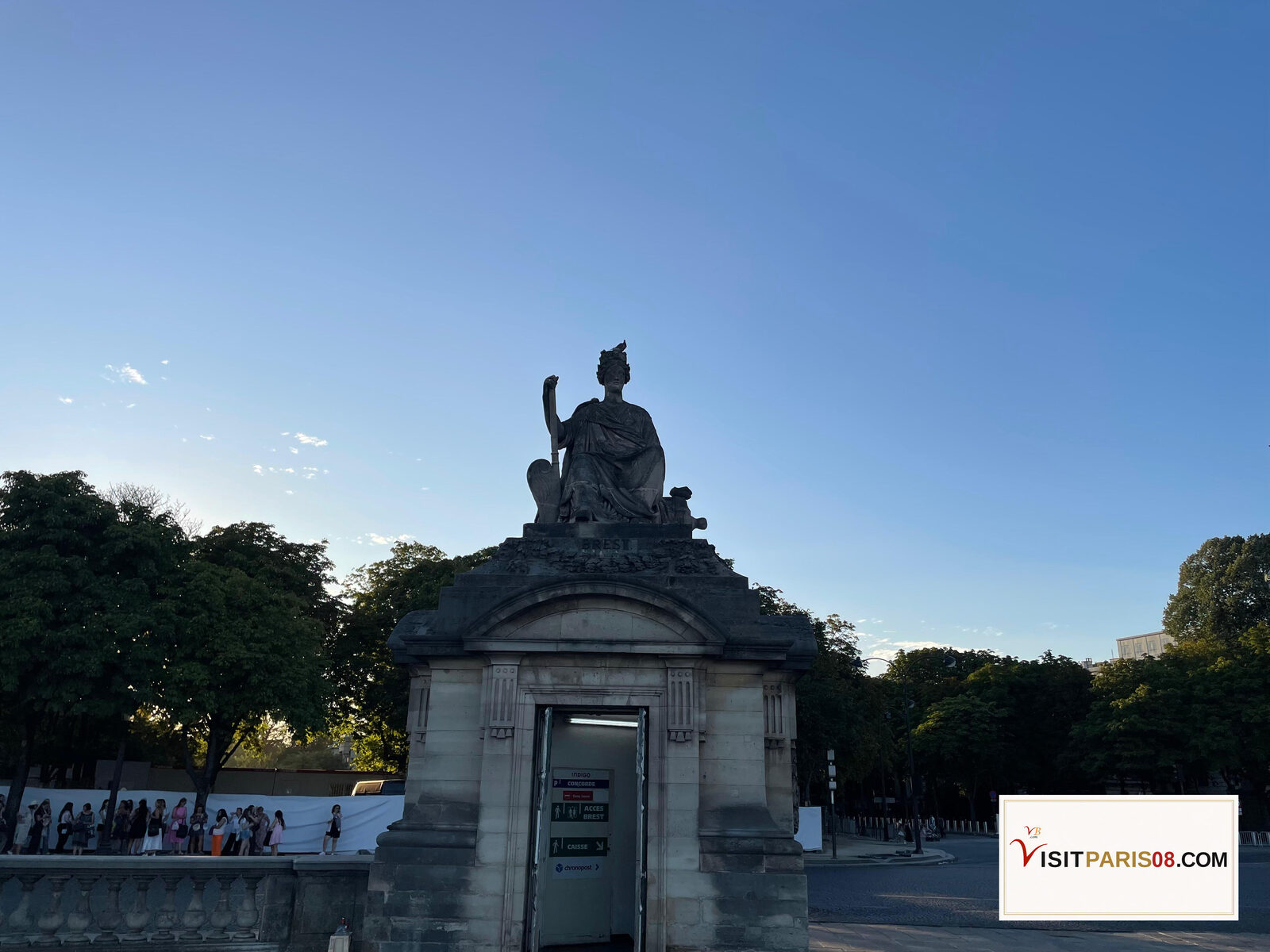
The statue of Brest
The Atlantic naval city of Brittany — a seated woman holding a ship's prow, gateway to the western seas.
Among the eight monumental statues that crown the corners of Place de la Concorde, each representing a great French city as a seated woman wearing a mural crown, Brest was carved between 1836 and 1840 for the redesign of the square under King Louis-Philippe, led by the architect Jacques-Ignace Hittorff.
History & sculptor
Brest sits on the western edge of the square, turned toward the Atlantic. Carved by Jean-Pierre Cortot — who also gave the square its statue of Rouen — she evokes France's great naval arsenal, the deep-water port from which fleets have sailed since the reign of Louis XIV.
A woman for a city
Like her seven sisters, Brest is a woman: the allegory of the city as a protective, sovereign figure. The mural crown she wears — a diadem shaped like city walls and towers — has symbolised a fortified city since Antiquity. She was placed on the north-west side of the square, turned toward her own region of France.
- 🏛️City representedBrest
- ⛏SculptorJean-Pierre Cortot (1787–1843)
- 📅Period1836–1840 · reign of Louis-Philippe
- 📍LocationNorth-west side of Place de la Concorde, 75008 Paris
- 👑AttributeMural crown — emblem of a fortified city
- 🌐Part of
The eight statues on Place de la Concorde
The map is centred on the Luxor Obelisk so you can take in all eight city statues at once — the one you are viewing, Brest, is marked in red.