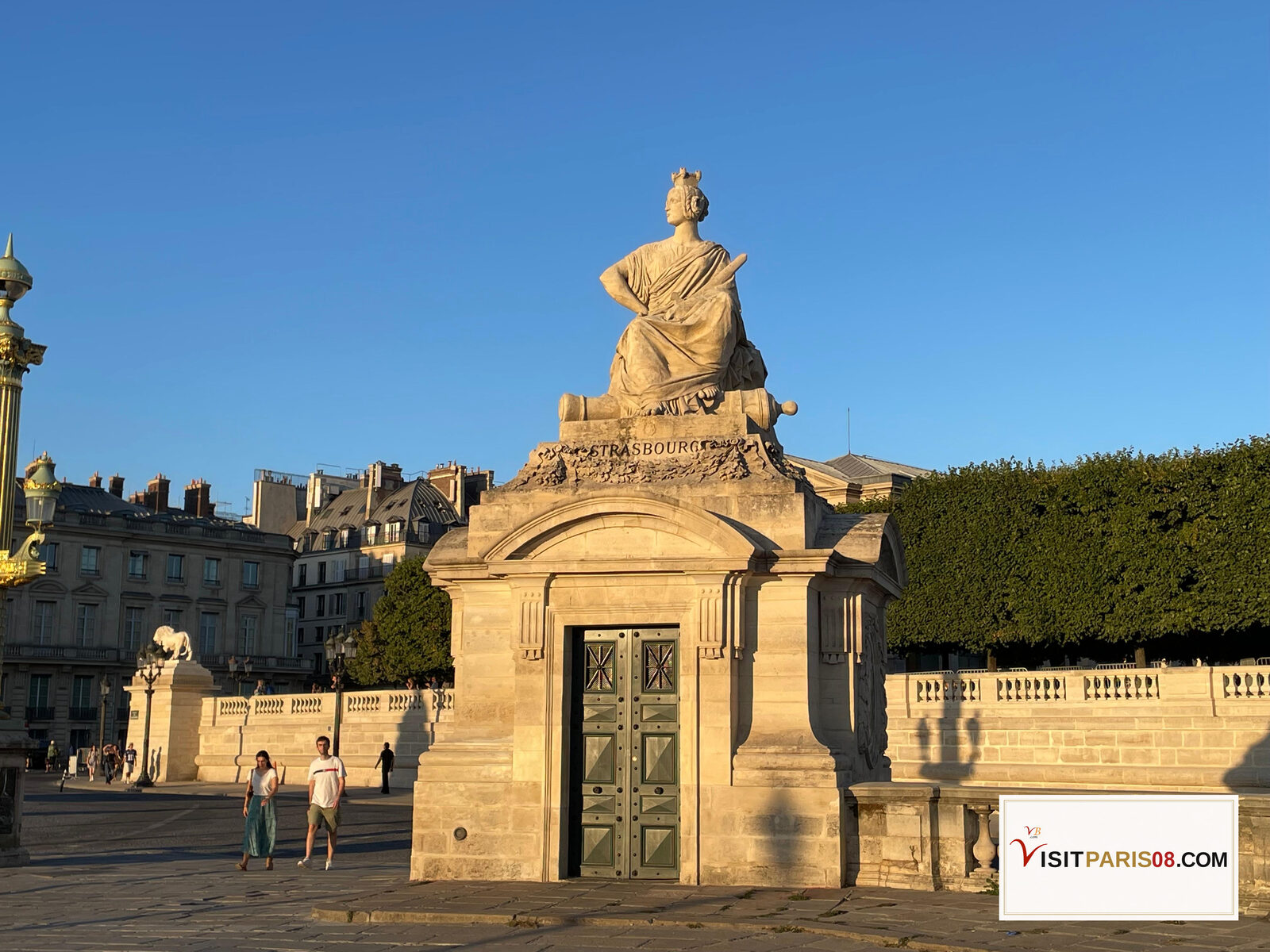
The statue of Strasbourg
The Alsatian sentinel of the Rhine — draped in mourning after 1871, she became a shrine of the French nation.
Among the eight monumental statues that crown the corners of Place de la Concorde, each representing a great French city as a seated woman wearing a mural crown, Strasbourg was carved between 1836 and 1840 for the redesign of the square under King Louis-Philippe, led by the architect Jacques-Ignace Hittorff.
History & sculptor
Strasbourg is the most famous of the eight. After France lost Alsace and part of Lorraine in 1871, Parisians draped her statue in black crepe and heaped it with wreaths and flags; for nearly fifty years, until 1918, she was a national shrine and a rallying point of patriotic memory. She is the masterwork of James Pradier.
A woman for a city
Like her seven sisters, Strasbourg is a woman: the allegory of the city as a protective, sovereign figure. The mural crown she wears — a diadem shaped like city walls and towers — has symbolised a fortified city since Antiquity. She was placed on the east side of the square, turned toward her own region of France.
- 🏛️City representedStrasbourg
- ⛏SculptorJames Pradier (1790–1852)
- 📅Period1836–1840 · reign of Louis-Philippe
- 📍LocationEast side of Place de la Concorde, 75008 Paris
- 👑AttributeMural crown — emblem of a fortified city
- 🌐Part of
The eight statues on Place de la Concorde
The map is centred on the Luxor Obelisk so you can take in all eight city statues at once — the one you are viewing, Strasbourg, is marked in red.